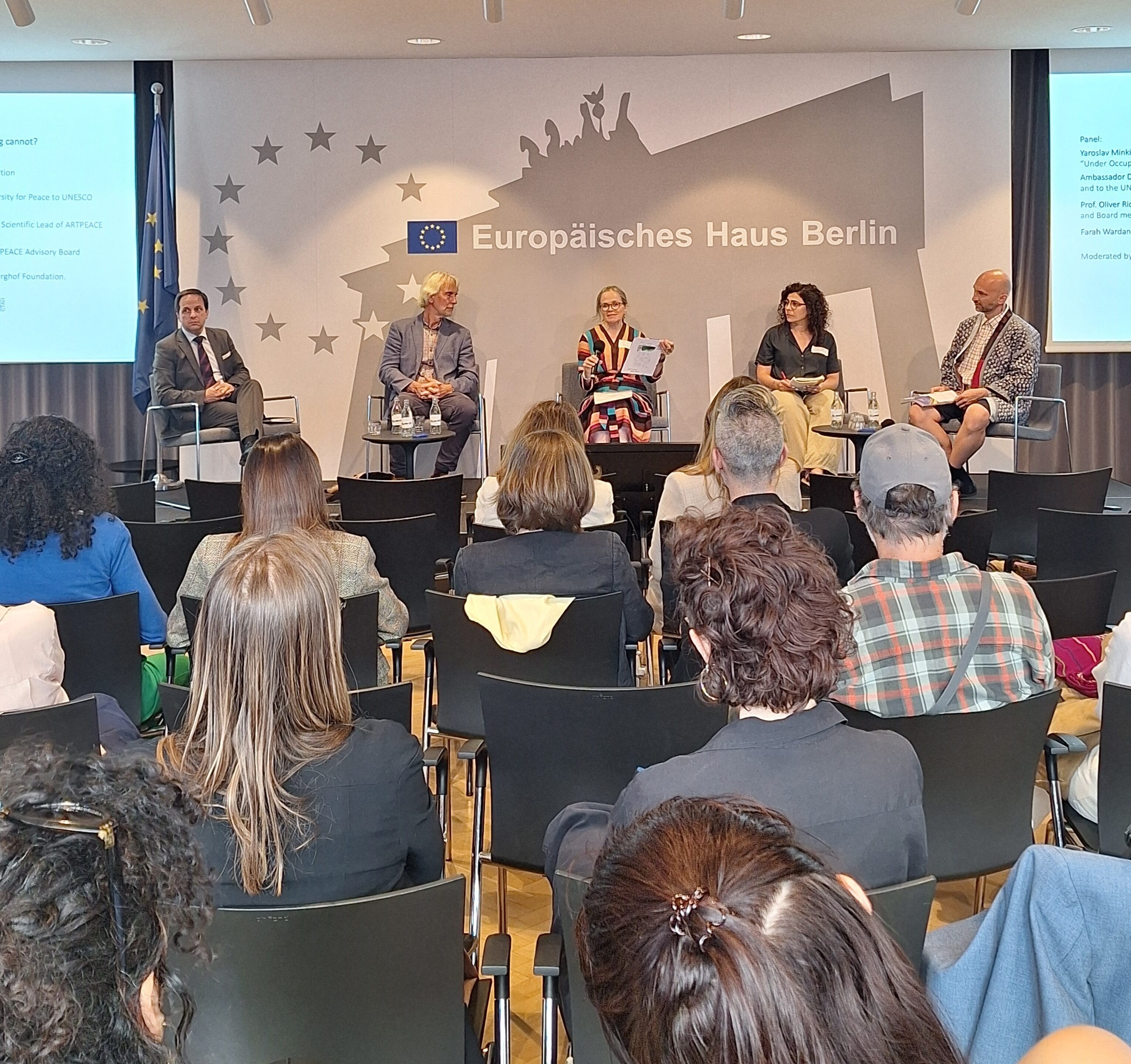
On 9 June 2026, ARTPEACE officially launched with a vibrant public event at European House Berlin, bringing together artists, researchers, peacebuilding practitioners, policymakers, and members of the public to explore the role of arts and culture in building peace.
The evening reflected one of ARTPEACE’s central convictions: peace is not shaped solely through political agreements and diplomatic negotiations, but is also imagined, challenged, and sustained through culture, memory, heritage, and artistic expression. At a time when formal peace processes often struggle to deliver lasting and just outcomes, ARTPEACE seeks to explore how artistic practices rooted in communities can contribute to conflict transformation and help create more peaceful societies.
The event opened with a film screening, setting the scene for an evening of reflection and discussion on the connections between creativity, conflict, and social change. This was followed by a panel discussion entitled What Can Art Do That Traditional Peacebuilding Cannot?, moderated by Beatrix Austin, Head of Conflict Transformation Research at the Berghof Foundation.
Brining together perspectives from diverse conflict-affected contexts, the panel featured together Yaroslav Minkin, founder of the Ukrainian youth organisation STAN; Ambassador David Fernandez Puyana, Permanent Observer of the United Nations University for Peace to UNESCO and to the UN Office in Geneva; Oliver Richmond, Professor of Peace and Conflict Studies at Manchester University; and Farah Wardani, theater artist from Lebanon.
Together, the panellists explored how artistic practices can challenge dominant narratives, create spaces for dialogue, amplify marginalised voices, and enable communities to imagine alternative futures. The discussion also examined the possibilities and limitations of arts-based approaches, highlighting the importance of bringing artists, researchers, policymakers, and peacebuilding practitioners together to exchange perspectives and explore new ways of working.
The evening continued with a live performance by Berlin-based Palestinian singer Rasha Nahas, whose music offered a moving reminder of the emotional, cultural and human dimensions of peacebuilding. Guests also had the opportunity to visit an exhibition curated by the ARTPEACE consortium partners In Place of War and STAN, featuring artistic works connected to themes of conflict and social transformation.
The launch marked an important first step in bringing ARTPEACE’s ideas into the public conversation, creating space for exchange between artistic, academic and peacebuilding communities. We are grateful to all speakers, artists, partners, and attendees who joined us for this memorable evening.
As ARTPEACE moves ahead, we look forward to continuing these conversations and exploring how artistic practices can open new possibilities for dialogue, reconciliation, and conflict transformation. Follow #ARTPEACE to stay connected with the project’s activities and developments.